
Embed Code
Khotso Mogotlane
"My hope is that the world can come together the same way that we come together when a neighbor’s house is burning. Because the earth’s fever is really concerning."
 Solutions
Climate Reality Leader Trained: Cape Town, 2025
Khotso Mogotlane
Living in Cape Town, South Africa, Khotso Mogotlane saw how pollution and climate change were transforming the oceans he loved so deeply. Taking a huge risk, he quit his job and launched Hotlane Organisation, a youth-led and empowerment organization dedicated not just to protecting the oceans, but repairing the deep relationship between humanity and nature.

What brought you to climate in the first place?
There was always something that kept on knocking in my mind and I never paid attention to what it was. All I wanted to do was to just have a good income and live a good life and travel the world. But in all the years I actually would feel like something is missing.
During the year 2019 I attended the first maritime security conference in Cape Town’s Simons Town and I realized one important thing that was not being discussed and that was conservation of ocean life. Instead the topics included economic opportunities and business opportunities.
That kind of made me angry and made me want to do something about it, but I still did not know what it was that I could do.
Then COVID happened and I had much time to reflect on who I was. The most two important questions for me were “What exactly have I been contributing to this life?” and “What exactly is my purpose?”
My maternal grandparents were environmentally and spiritually focused and my paternal side was more of political activists. So looking at who I am and where I am, which is in Cape Town, the most vulnerable thing is the ocean.
I started learning about the ocean’s impact on climate change. During that research I knew that this is where my road begins. I just knew.
How did Hotlane start?
Hotlane was registered during COVID-19 in April 2021. Me and my two housemates were taking a stroll in the city, walking past the Western Cape Government offices in Cape Town and noticed they were open.
I entered and enquired about opening a nonprofit organization. They said it was free to do so and provided me with all the details I need to start.
I went back the following day to register Hotlane. “Hotlane” is the letters of my name and last name combined. I had no clue where I would end up and that did not bother me at all because I was finally in a journey that keeps nurturing me.
Tell me about the work you do.
The work that we do is about healing the relationships that people have with their communities and environment and bridging the gaps between the regular education and economic systems. We create a relationship infrastructure between academia, scientists, local communities, and their stakeholders from community leaders, religious institutions, schools, and orphanages.
We bring all these stakeholders that usually never meet and get them to share their stories and different journeys with each other and participate together in community cleanups, tree planting campaigns, and climate and ocean literacy.
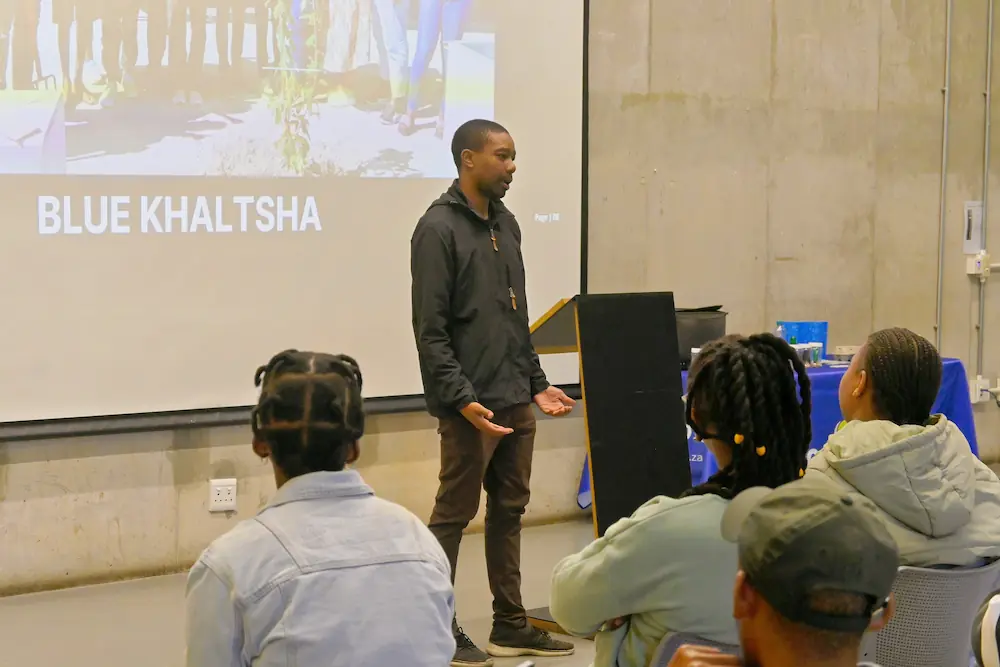
Plus, our Blue Khaltsha Project includes physical and psychosocial therapy as part of the healing process from the post-oppression shock that the African continent is not fully addressing.
This is the important work that helps communities embrace the transition whilst at the same time having the basic skills to cope with yet another shock that might come from a just transition and encourages a more prepared mindset for climate adaptation.
Together with the Southern African Students Union, we work with the current university students and graduates because they are the majority and the majority wins, right?
People will actually contribute when they are given the opportunity to do so. They are just waiting for a genuine relationship with whoever is available to share this knowledge and work with them.

Why now?
The youth are 1.9 billion-plus in this continent. However the economic structures that exist are mostly forged by problems that have already been solved by the preceding generations, and the communities are still impacted psychologically by the traumas of the past.
However, I see them as having an extra advantage rather than at a disadvantage. They are surrounded by new opportunities and they have the Indigenous knowledge that the world did not regard as important before.
My hope is that the world can come together the same way that we come together when a neighbor’s house is burning. Because the earth’s fever is really concerning.
How has training with Climate Reality shaped your work?
The training helped me to shape my own story of advocacy, and understanding of the climate impacts that affect different regions in different ways. The training made it easier for me to make a connection between environmental and social issues, governance, policy, and climate change.
It made me realize that I am not alone in this journey, and that boosted my drive to be honest
Tell me about a moment when you realized your efforts were making a difference.
I kept on receiving encouragement from people that I hardly spoke to, or people I never met before. The conversations started changing and felt more meaningful. Till today, those small moments I will always appreciate and keep them in a special place in my heart.
During the networking sessions that I used to host, I met like-minded people from all over the world. When they heard about what Hotlane does, they all wanted to hear my story.
What was the hardest or scariest part?
The scariest part for me was when I decided to fully commit to this work and resign from my full-time job in December 2024. Where I was going to get income? How will I survive? These were the scariest questions.
I survived on reserve funds saved and for a couple of months through a friend that I had helped when he was also in a tight spot. The work kept on growing. The recognition kept coming but my survival instincts kept on lingering. I eventually got a remote contract job from Africa Center for Workbased Learning to help with their social media engagement. That contributed a lot and relieved a lot of pressure.

What has surprised you most?
People will actually contribute when they are given the opportunity to do so. They are just waiting for a genuine relationship with whoever is available to share this knowledge and work with them.
Was there a moment when someone else stepped up or got involved because of your work?
Oh yes. The first one I believe this was in 2024, after my talk at the Cape Town University of Technology, when one of the students sent me a message to say they have organized a beach cleanup activity.
And it felt really good. His journey though was somewhere else but there have been many others that either say I inspired them or simply just start something on their own that contributes to a better planet
Looking back, what moments quietly mattered more than you realized at the time?
Quiet moments and choosing to walk my own journey. The small, slow deliberate decisions like not moving with the crowd, not going out to parties, getting to know myself. Change starts with me, and the world will play it back like an old-school VHS.
What keeps you going?
The people whose lives have been impacted by this work, especially those that take up arms after our activities and implement in their own communities. The mountains and the oceans give me a lot of inspiration.
What's next?
Setting up branches across different parts of the African continent. That for me is what comes next.
The only thing I am up against is the previous day’s version of myself. I am always curious and looking to be better than yesterday.
Think back to the version of you before you got involved. What would you say to yourself?
I would say that there is no light at the end of the tunnel. You are the light and don’t be afraid to let it shine because that’s how things get better.
I would say it’s okay to not have everything figured out. What matters most is just that first step, because without it we wouldn’t be walking.
Was there something you were worried about that turned out not to matter as much as you thought?
I would say it’s okay to not have everything figured out. What matters most is just that first step, because without it we wouldn’t be walking.
What would you say is the kind of person who can make a difference?
Someone who appreciates the little things, because the little things make a big difference.
